

AMAP began in June 2018 to reforest a wildlife corridor. In this multi-year project, the farm’s now abandoned cattle pastures are reforested with native tree species, supported by volunteers from Germany and Brazil. The corridor will connect two larger forested areas, thereby combating habitat fragmentation of endangered golden-headed lion tamarins and other species. The project area is located on Bahia’s cacao coast, a landscape dominated by traditional cocoa agroforestry systems (cabrucas). Lion tamaris can use cabrucas as habitat when specific key tree species are present for foraging and as sleeping sites. The area around Fazenda Bom Pastor, is one of only two areas where lion tamarins are still found with larger populations and therefore has a major importance for the long-term survival of golden-headed lion tamarins. There are approximately 17-20 family groups living in the area, each with between 4 and 12 individuals.So far, 46 hectares of abandoned cattle pastures have been reforested with about 50,000 seedlings. Since 2018, more than 80 native tree species have been planted. Approximately 75 percent of the species planted are pioneer species which shows a high tolerance to direct sunlight and have a rapid growth. Moreover, some pioneer species improve and regenerate the soil fertility and provide shade to the areas to compete with dominant grass species. The other 25 percent of the species planted are secondary and climax species, typical forest species. Both successional classes are planted in alternating rows, 2 x 3 meters apart. This is a proven planting scheme and is used in most reforestation projects that serve restoration purposes. The seedlings are obtained from the local nursery Floresta Viva. Key tree species are also planted that will provide food or sleeping sites for lion tamarins such as Eugenia sp., Protium heptaphyllum, and Pouteria grandifolia, regarding the tree species list of Prof. Leonardo de Carvalho Oliveira, who identified and prioritized the most important species for golden-headed lion tamarins.


The reforestation sites: The first area was reforested in 2018, followed by another area each year until 2021. Since 2022, the reforestation areas are maintained to ensure good growth of the seedlings.
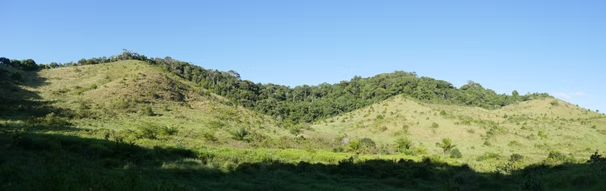
The abandoned cattle pasture of Fazenda Bom Pastor in 2018, before we started with the restoration process
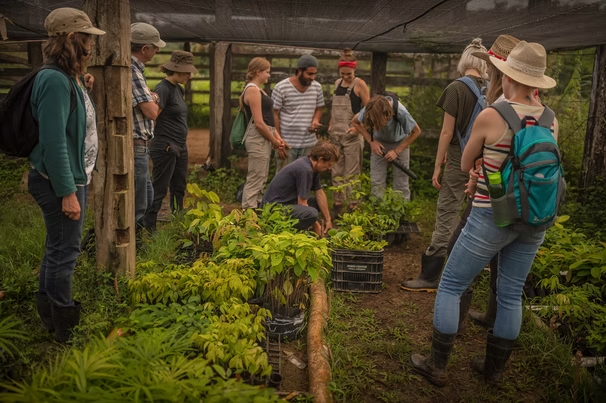
In a small greenhouse, nearby the reforestation sites we stored the seedlings until they were planted by volunteers.
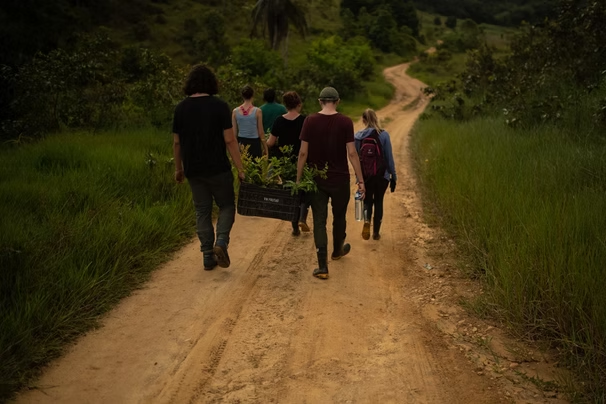
Volunteers of Germany and Brazil were an essential part of the reforestation periods in 2018 and 2019.
Over 50,000 native trees could be planted between 2018 and 2021 on the project areas. The most abundant planted species you can find on our site of tree species. The complete list of planted species you can download here.
Our Partner
